Don't say
"You need to eat more vegetables, you're gaining weight."
A parenting field guide ◆ no diets ◆ no shame ◆ no food battles
How to help your overweight child get healthy — without the shame, the food battles, or the eating disorder you're terrified of causing — starting this weekend.
Five phases ◆ Five tools ◆ One quiet change
$79 $12 · PDF · Instant download · 64 pages
the kitchen, observed ↓
So you say something, and you hear it come out wrong: too careful, too casual, too much like a rule. Or you say nothing, and the silence has its own meaning. Both of those are answers your child will keep.

A diet announced to one kid at a table of three is a verdict on that kid, and it is remembered as one — word for word, thirty years later.
Good food and bad food becomes a good child and a bad child faster than any parent expects, and that is the road to eating in secret.
Anything that needs a child to keep choosing correctly fails in the first week that goes badly — and then everyone feels worse than before.
The battle over seconds becomes a nightly event, with you on the other side of the table from your own child.
The alternative is not a cleverer rule. It is a household that quietly makes the reasonable choice the easy one, and a way of talking that never puts a child's body on the table. Change the household, not the child.
While you were reading, this fridge re-shelved itself.
Nothing banned · nothing announced · that's the whole method
"By Monday morning, the house runs differently. Nobody's been told why." — Phase 1 · The Silent Reset
Zero-effort food becomes the default. It's physics, not a moral failing.
Like a grocery store — the good stuff sits where the eye lands first.
Not banned — just behind a door. One extra step kills the habit grab.
Zero prep between "hungry" and "eating it."
The grab a bored hand makes, on purpose now.
Middle shelf, front row, no commentary attached.
Still in the house. No longer the first thing seen.
Part of the rhythm — just not the default anymore.
Entrée and starch served identically — the same reasonable serving for every kid, no exceptions made visible.
Nothing to compare, nothing to comment on. Nobody can tell which kid this book is about.
Family-style in the middle. Seconds on anything? A calm yes — no eyebrow, no "are you sure."
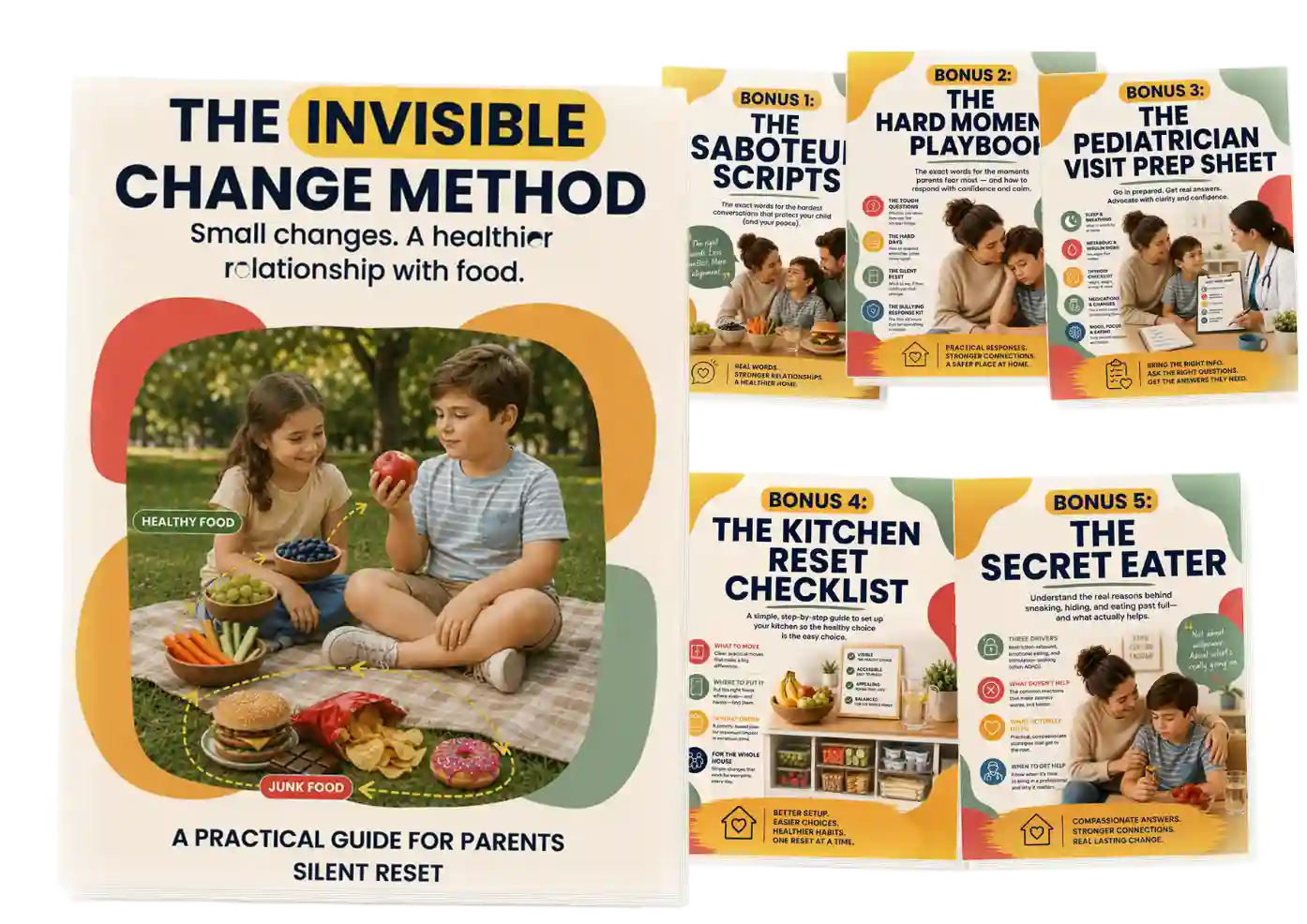
All five come with the field guide at no extra cost. Separate printable files, so you can take just the one you need to the kitchen, the appointment, or the conversation you are dreading.
 Bonus 01
 Bonus 02
 Bonus 03
 Bonus 04
 Bonus 05
The guide, the five phases and all five bonus files — one payment, nothing renews, and the download is on your screen a minute from now.
Instant download · 64 pages · printable PDF
Your child doesn't hear what you meant. They hear the words, in your voice, at a moment they'll remember long after you've forgotten saying it. So before it leaves your mouth, run it through the filter:
The filter
Don't say it — not even gently. A kind version of the wrong sentence is still the wrong sentence.
Say it. Keep it to what their body can do, never to how it looks.

The filter, applied
Three sentences most parents have said. Each one moved off the child's weight and onto what their body is for.
"You need to eat more vegetables, you're gaining weight."
"Vegetables are what give you the energy to keep up at soccer practice."
"Let's go for a walk, you've been sitting too much."
"Let's go for a walk, I want to hear about your day."
"You don't need seconds."
Nothing at all — in this house, second helpings stopped being something anyone remarks on. Saying nothing is a choice too.
If you are already seeing signs of an eating disorder — meals skipped on purpose, exercise that goes on even when they are exhausted or hurt, food hidden and eaten alone, real distress around eating — close this book and call a professional today. Not next week.
If a doctor has found a medical reason for your child's weight, the specialist who found it leads. Nothing in this book overrules what they tell you.
If you already have a plan from a doctor or dietitian, stay on it. This is the part that happens at home between appointments, not a second opinion.
Everyone else — the parent awake at 11pm, worried about where this is heading, with no plan yet — keep reading. This was written for you.
No, and that is the point. Phase 1 changes the kitchen with nothing announced. Phase 2 is about what you say when the subject comes up on their timeline — not about sitting them down.
The household changes work wherever the child still eats what the house eats. The conversations chapter is written for a child old enough to ask, and Phase 5 deals with puberty specifically — when a plateau is a pattern and when it is simply growth.
Phase 3 is that problem, and in practice it is a third of the work. A spouse, a grandparent, an ex or a school pulling the other way undoes a kitchen faster than a child does.
Immediately. The download is available the moment payment completes, a confirmation email follows, and the file also stays on your delivery page — so a lost email is never a lost book.
No. It is educational, it diagnoses nothing, and it does not replace your pediatrician or dietitian. If a doctor is already involved, this sits alongside what they told you — and page 6 says plainly when to close the book and call someone.
Nothing here guarantees a result. Children, households and circumstances differ, and no book can promise a change in yours. What it gives you is the order to do things in, and the words for the parts that go wrong.
No. It is a digital file delivered instantly and you cannot un-read it, so all sales are final — the refund policy says so plainly, and this page says it before you buy rather than after.
You can buy it and pass the file on — it is yours to print and use in your own household. Access is tied to the email the order was paid with, so buy it from an address you can reach.
Separate printable PDFs, not chapters — take the one you need to the kitchen, the appointment, or the conversation you are dreading.
What to say to the person in your family who keeps undoing it — word for word, for the sweets at the door and the "one won't hurt".

The exact wording for the questions you cannot rehearse: the one at bedtime, the comment from another child, the photograph they do not like.

One page to bring with you, so a seven-minute appointment ends with a plan written down instead of a shrug.

Phase one, room by room and shelf by shelf, as something you tick off rather than something you remember.

The deeper look: what hidden wrappers actually mean, and what to do about them that does not turn into a confrontation.
"You started this because you were terrified of getting it wrong. You're finishing it as the parent who quietly got it right."
First edition · 2026
$79
$12
Printable PDF · 64 pages

The download appears the moment payment completes, and a confirmation email follows. Your access also lives permanently on a delivery page, so a lost email is never a lost book.
Taken by Whop on their own secure form — card details never touch this site. Your statement reads ICM · FIELD GUIDE. One payment; nothing renews.
A file that will not open is ours to fix — write to support@invisiblechangemethod.com and we get you the file. All sales are final, which is why everything above is published before you pay.